Reading Dolmenwood
The Best Fantasy Lit of 2025?

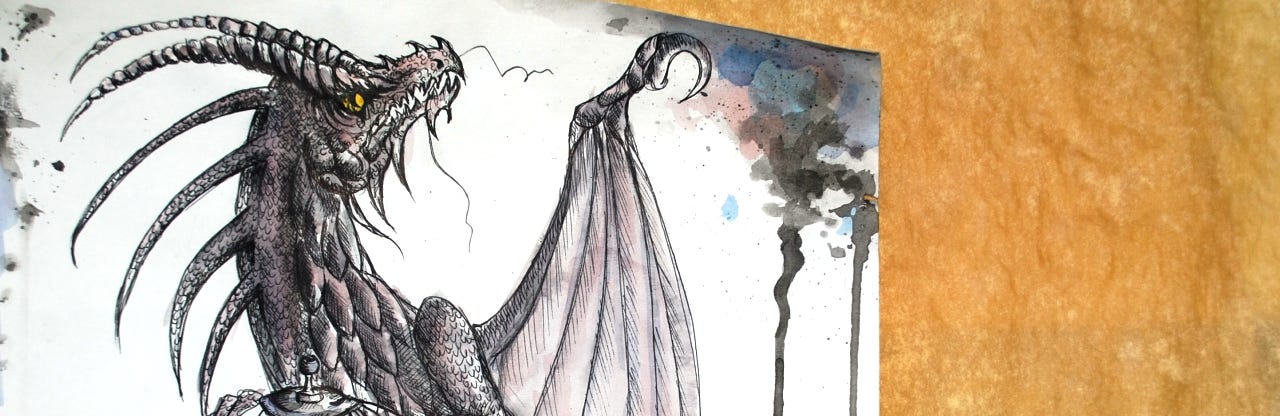
Caveat first: I have not read a ton of new fantasy books from 2025. I did read the conclusion to Mark Lawrence’s Library trilogy (which was excellent), and I have read other new-to-me SFF this past year (loving Lincoln Michel’s The Body Scout so far), so my naming of Dolmenwood as 2025’s “best” is highly subjective, biased, and rather ill-informed as far as “what’s new” with SFF.
But despite all those gaping holes of credibility, I’m still going to name Dolmenwood RPG the best fantasy literature of 2025.
Yes, you read me correctly. A role-playing game (particularly including its bespoke setting) is the best piece of fantasy I’ve read in quite some time. (This is not including those older classics I’ve read recently, just talking about newly-published stuff.)
(For a video run-down of what makes Dolmenwood a great RPG, with lots of images of the books, watch Questing Beast’s review HERE.)
Of course, I was always destined to like Dolmenwood. It has nearly all of my favorite things in fantasy. As a British-flavored, folklore and fairy tale-inspired world, it hits all my obsessions. I was on-board with the setting from first reading the old Wormskin zines, and I’m an OSR gamer, so I was always going to vibe with its rules-set and approach to the hobby.
But when the Dolmenwood Kickstarter fulfilled, first with PDFs and later with the physical books, I was utterly blown away by the breadth AND depth of what creator Gavin Norman had done.
Now that I’m reading through the massive Campaign Book and evocative Monster Book (coupled with my rereading of the Player’s Book), I am convinced that Norman’s creation is one of the most notable entries into fantasy literature in quite some time.
Granted, an RPG is not “literature” in the normal sense of the word. Literature implies story, narrative, novels, etc. And an RPG like Dolmenwood—despite including story threads and narrative hooks for gaming—does not tell a unified, beginning-middle-end story. It’s not A Narrative. It’s many possible narratives, some narrative seeds, it’s certainly world-building at its most intricate and immersive, but it’s not a novel or short story; it’s not a TV show, comic, or film.
And yet, it’s a work of art.
Dolmenwood (like many RPGs with deeply-developed settings) consists of many of what Jane Smiley calls the “discourses” of a novel: travel, history, biography, the tale, the joke, gossip, diaries and letters, confessions, polemics, essays, the epic, and romance (hat tip: Matt Bell via his book Refuse to Be Done).
What else are the hundreds of pages of hex descriptions but a collection of geographical and travel-related details, history, gossip (in RPG parlance, “rumors”), jokes, and tales? The information on major NPCs within the world are all mini-biographies, and the divine magic section of the Players Book functions as a gamified Lives of the Saints. A setting-based RPG like Dolmenwood is an exercise in “world-building” (as everyone knows the term), but the cohesion and depth of Norman’s world-building is literary: it has a quality of imagination and unity that marks it as something expertly crafted, not just in the gaming sense (i.e.: mechanics, procedures, a particular experience at the table, etc.) but in the aesthetic sense. Dolmenwood is as fully realized as any literary secondary world from a novel or series of novels.
The sections on food, beverages, pipeleaf, and herbs and fungi illustrate this quite nicely. Norman has a gift for names that permeates all levels of Dolmenwood, from kindred character names (grimalkins can have names like Lady Pouncemouse, elves names like Glance-Askew-Guillem) to the names of saints (St. Whittery of the Woods, St. Pastery the Butter-Monger), to the names of food and drink.
(Looking for some common fare? Why not try some Pook’s pudding — “a sooty pudding of mallow and locally foraged mushrooms” — or Puggle pie — “puggle-flesh [puggles being ‘fungivorous dogs’] and mushroom gravy in flaky pastry” — with a side of Ruddy chad, “a hunk of mature, red-veined cheese”?)
We have beers with names like Cobsworth Pale and Marrowhyte Dark, wines called Faggley’s Iced and Lady Mauve, and spirits christened Pokey Nog and Porrid’s Full Moon. And each of these beverages come with particular effects. Want to attempt feats of romantic daring? Try a glass of Cold Prince wine, “a colourless, bubbling wine always served on ice.” Want to have some “jovial banter” with your fellow tavern-mates? Sip a glass of Moon’s Milk.
These might seem like small things, but the names and effects of these things matter for the success of the fiction and world-building. The fact that Norman has optional rules for inebriation and the smoking of pipeleaf means these aren’t just flavorful add-ons but parts of the world players can interact with and feel the effects of on their characters.
When I say that Dolmenwood is “fully realized,” this is what I mean. The cohesion of all these details adds up to a world that is more than just a game setting (though it is also an eminently playable game setting). Role-playing games don’t need worlds of this level of detail to be playable or fun. I’ve run many a one-page dungeon or randomly generated hex crawl at my tables and the players have had immersive experiences with them.
But Dolmenwood does something a little different, even than the old TSR Gazetteers from the BECMI sets of the 1980s (which, no shade on the Gazetteers! I love them and they also have wonderful world-building). What that difference is has to do with Dolmenwood’s merging of real English/northern European folklore with the various literary influences of the game (Jonathan Strange and Mr. Norrell, Mervyn Peake’s Gormenghast novels, Over the Garden Wall TV show, Jim Henson’s Labyrinth, the early parts of Fellowship of the Ring, etc.). It’s inevitable that when we fantasy writers world-build, we take things from different human cultures and play the “what if?” game to make them slightly (or more than slightly) different from their real-world analogues. Norman does the same with Dolmenwood, but because the world he’s built is limited—it’s just the Dolmenwood, not an entire continent or country even—he can be more focused in his influences, more selective in his real-world analogues. Dolmenwood is like an English forest, but it’s also a very particular kind of fairy tale forest too—there are many more details and influences than we would get in a real fairy tale forest, but the area is still limited. We get a world that has incredible depth and a certain level of breadth—but not too much breadth. The details are seemingly minor but they are not superficial. What you can order from the tavern or find foraging in the forest are precisely the things that make the world hum with life. This is much more important for the imagination than every last minute detail of the line of kings or military battles.
Which is to say, Norman hasn’t detailed everything. What Hoarfrost Keep is like on the inside is left vague; there are barely any dungeon maps for anything except what’s contained in the companion adventures; and what the fairy realm is actually like is left intentionally impressionistic: we get some mention of particulars, but nothing is spelled out in nearly the same detail as what we get for the human settlements and hex locations (this is partly because Dolmenwood centers the mortal kindreds’ experiences of the world over the fairy-folks’).
But world-building is not about describing every minute detail. In RPGs (as in fiction), it’s about making a world that feels alive, that opens up imaginative possibilities for the reader/player to enter into. I think it’s very telling that Dolmenwood has already populated my imaginative vocabulary: It’s winter here in Michigan, and as I look out over the backyard where every tree is sagging with the weight of heavy snow, I can’t help but think of the Cold Prince and his frosty malevolence encroaching upon the landscape. The spirit and sensibilities of Dolmenwood have become nearly as fertile for my imagination as that of Middle-Earth and Narnia. I think this is because Norman draws from the well of real folklore; the Cold Prince isn’t a real character from folklore, but he feels as if he could be.
Of course, being a game and not a novel means Dolmenwood has no overarching narrative or protagonists, and thus there is little of the psychological depth in characterization we might find in a novel. The characters (NPCs) of the world are sketched in brief, and although those briefs are filled with evocative details, there’s no depth yet to these people; that’s for the players and game master to discover and create through game-play. Similarly, an RPG lacks protagonists until the players themselves become characters within the world.
So no, Dolmenwood cannot provide the same richness of emotional insight and empathy that a novel or short story can. But the fantasy novel, as such, has always lived in tension between the richness of characterization and psychological depth expected of the novel, and the descriptive setting and world-building details expected of sub-creation. Fantasy as a genre is not just about characters facing conflict and change; it’s as much about the realm of Faerie itself, whether that realm is explicitly in the story or on the edges of it. We want characters and emotion and plot and all the rest, yes, but we want the sub-created world too. We want Earthsea, and Westeros, and the magical world of Harry Potter operating in the cracks and shadows of muggle England.
What RPGs can give us—especially ones like Dolmenwood where the setting of the game IS, in some ways, the game itself—is all the world-building elements, the map of Faerie and its history, its rumors and jokes and games and biographies, its fashions and customs, all of that stuff, and then we add the narrative and character elements ourselves. There are RPGs that don’t include any speculative fictional elements, but there’s a reason why the hobby is dominated by Fantasy, Science Fiction, and Horror. Those of us who love these genres love them in part because they create Otherworlds for us to imagine. It’s not that we don’t want rich characters and interesting plots, but we often equally want rich worlds and interesting lore.
I wonder if some SFF novelists might have been better served by writing RPGs like Dolmenwood first and then adding short stories and novels later (i.e.: Dragonlance, the Forgotten Realms books). Instead, what we sometimes get is a series that starts off focused on character and story that gets overwhelmed by world-building, by endless fleshing out of regions and cultures, so much so that the original characters and plot get lost in the expanse.
An RPG like Dolmenwood avoids this problem because it’s not trying to craft characters or plots at all; it’s all world-building. There are seeds for plots, sketches for possible characters, but it reads more like a chronicle, a history, a geography, and a compendium than like a novel. And yet, I find it utterly immersive. It’s a wonderful read! All the cohesion and attention to detail that make it work as a playable game also make it work as a piece of imaginative fantasy literature.
I suppose what I’m getting at is that fantasy, as a genre, is able to function as literature even when it lacks in some of the things we’d traditionally ascribe to good literature: plot structure, characterization, etc. Dolmenwood has themes, it has setting (in abundance), and it fulfills two of the three functions of fantasy that Tolkien lays out in his essay, “On Fairy-Stories”: Escape and Recovery. Escape, because it shows us an Otherworld seemingly more alive and enriching than our own drab machine age, and Recovery, because it makes us see the ordinary with renewed “vision” (see my note about the Cold Prince and winter above).
As far as Consolation goes, that depends on the players’ choices and the fate of the dice. If the game ends happily, then we get our eucatastrophe. If it does not… well.
But if the players and game master continue playing, rolling up new characters and embarking on new adventures, then Consolation should come eventually, and perhaps when least expected.
There is a critique to be made that Dolmenwood is simply a mash-up of influences—Norman himself lists them at the start of the Player’s Book—but I think this misses the way in which the folklore, fairy tales, fantasy, and pop culture all hold to a particular sensibility that holds all these various pieces together and decomposes them into something new. The fungal nature of the Dolmenwood itself is an apt metaphor for what the text is doing: every influence has been composted into the nutrient-rich soil that feeds and grows the forest. We see the influence of Puss-in-Boots and the Cheshire Cat on the fairy kindred known as grimalkins (the name itself an evocation of Macbeth and witchcraft folklore), but they are not simply a vessel for literary allusion; the kindred is part of the fairy world, with its own monarch and kingdom, and the fairy kingdom itself has fairies of various shapes, sizes, colors, and types. The grimalkins grow out of a tradition within fantasy and fairy tale, but they are fully integrated into the tone of the world, a place at once whimsical and horrific.
Similarly, the woodgrues look to be inspired by the bat-faced creature from the opening of The Neverending Story, but Norman expands on the visual inspiration by crafting a mischievous kindred that echoes the Pied Piper and even hobbits (woodgrues love parties and merriment).
The text is full of these kinds of things, where you can see the inspiration but also the furthering of it so that everything fits into Dolmenwood, even as its tone can seem at times to be incongruous and these elements hard to reconcile. And yet Norman does reconcile them. Like a real forest, Dolmenwood is an abundant ecosystem, each layer growing upon what came before, like that fungal forest, everything interconnects via roots and networks that speak across times and places, genres and influences.
Because I think Dolmenwood is the most interesting fantasy text of 2025, I’ve decided to make 2026 the Year of Dolmenwood, both as a gamer (where I’ll be running several mini-campaigns), and as a reader. Which means I’ll be making my way through many of the “Inspirational Media” Gavin Norman lists in the Player’s Book. I’m hoping to turn this into a kind of “book club” here on Substack (inspired by other Substackers who have taken on similar projects), encouraging readers to join me in reading (and sometimes watching) the texts I’ve chosen from Norman’s list and discussing them here with me each month. My hope is to read/watch the chosen text each month and offer my thoughts in the newsletter (and on my blog). I’m embarking on this project mostly for myself, because I want to spend as much time as I can in the imaginative landscape that inspired the game, but I’ll be gratified if anyone else decides to join me. I'd love for this to start a larger conversation about Dolmenwood RPG, folklore and fairy tale fantasy, and classic works of fantasy literature overall.
The tentative schedule is below. I say tentative because as readers of this newsletter may already know, I can’t keep to a perfectly regular schedule simply because my life and work outside of writing often takes precedence over this Substack.
But this schedule is my hope for the year. And what doesn’t get covered this year may roll over to the next. Maybe 2027 will be the Year of Dolmenwood Pt. 2!
February: Mio, My Son (Astrid Lindgren)
March: “Goblin Market” (Christina Rossetti)
April: The Ladies of Grace Adieu and Other Stories (Susanna Clarke)
May: “Smith of Wooten Major” (J.R.R. Tolkien)
June: The King of Elfland’s Daughter (Lord Dunsany)
July: Lud-in-the-Mist (by Hope Mirrless)
August: Jonathan Strange and Mr. Norrell (Clarke)
September: The Fellowship of the Ring (part 1) (Tolkien)
October: Gormenghast (Mervyn Peake); Over the Garden Wall (dir. McHale)
November: The Green Knight (dir. Lowery); The Wicker Man (dir. Hardy)
December: Krabat (Otfried Preussler); Jonathan Strange and Mr. Norrell (BBC TV adaptation)
I’ll try to post something about the text at the end of each month. For example, I’ll post my thoughts on Mio, My Son at the end of February, “Goblin Market” at the end of March, etc.
I hope you’ll join me!
If You’re Looking for Other Books to Read
My new collection of short stories called Dark Was the Morning and Other Stories is available now. These are seven strange tales of various type: some weird fantasy, some old school dragon-y fantasy, some fairy tale fantasy, and a Merlin’s Last Magic prequel story about Merlin’s time in Atlantis. You can get the collection in ebook and paperback from all the usual retailers (and Hoopla!).
Please check out my other books as well (if you haven’t already):
The Thirteen Treasures of Britain (if you are looking for Arthurian fantasy)
Avalon Summer (if you want a dash of nostalgic coming-of-age, 1990s-style)
Gates to Illvelion (if you want a strange fantasy meant to evoke the style of Appendix N fairy-tales like The Last Unicorn or The King of Elfland’s Daughter)
(And have I mentioned that the main character of Avalon Summer, Sarah, finds and reads Gates to Illvelion and sees strange parallels between that book and her own life? Well, she does, and it’s weird!)
That’s it for now! Thanks so much for reading!
Remember, if you enjoyed this post but can’t afford a monthly subscription, you can always buy me a coffee.
This newsletter is run on a patron model. If you can support it with a paid subscription, I would be grateful.
As always, this newsletter remains free and open to all who want to join me in exploring the various contours of the fantasy genre. Thank you to ALL my subscribers!
It is a lovely set of books, with the artwork and layout. There is a soundtrack, as well as a much better collection of “ambient music” tracks.
Another literary source is *The Wind in the Willows*, but with a sort of dark, tragic twist.
The setting’s take on dragons, as giant, limbless creatures that are mapped to the four humors, is one of my favorite things.
The monster book is amazing. Each monster entry has charts to roll on to determine what a particular monster looks like, what it is currently doing, and what its lair might be. The addition of “Fairy” changes things up significantly. Goblins in Dolmenwood aren’t anything like Tolkien’s. When the party stumbles across some goblins, they might be in for a fight, but could just as likely find themselves negotiating for a basket of syrupy fruits from fairyland.
Scarecrows are jolly fellows in the spring and summer, insanely murderous in the autumn, and morose and insular in the winter.
The monster book includes guidelines for creating your own monsters, since some classic monsters, like vampires, are not included.
The rules are house ruled Moldvay B/X, but with a few improved resolution mechanics.
This article is great. Really gets me to want to get Dolmenwood and read it myself.